

Cicada Seeds
Perennial SkirretPink Mix
Skirret
Pink MixPerennial
Ecologically Grown
Couldn't load pickup availability
Sium sisarum
Skirret is one of my favourite perennial root veggies, and I'm very excited to offer seeds from this diverse pink skirret mix!
This mix is originally from Peter Laßnig of Ackerschön in Austria. Peter generously sent me some seeds in a trade. Peter first found the pink skin trait in a skirret screening he did over ten years ago with seeds from the gene bank Gatersleben. A few plants had a bit of colour, but the roots were very fibrous. He spent years improving the quality and intensifying the root colour, and the selection work is still ongoing- both in Austria and now at Cicada Seeds!
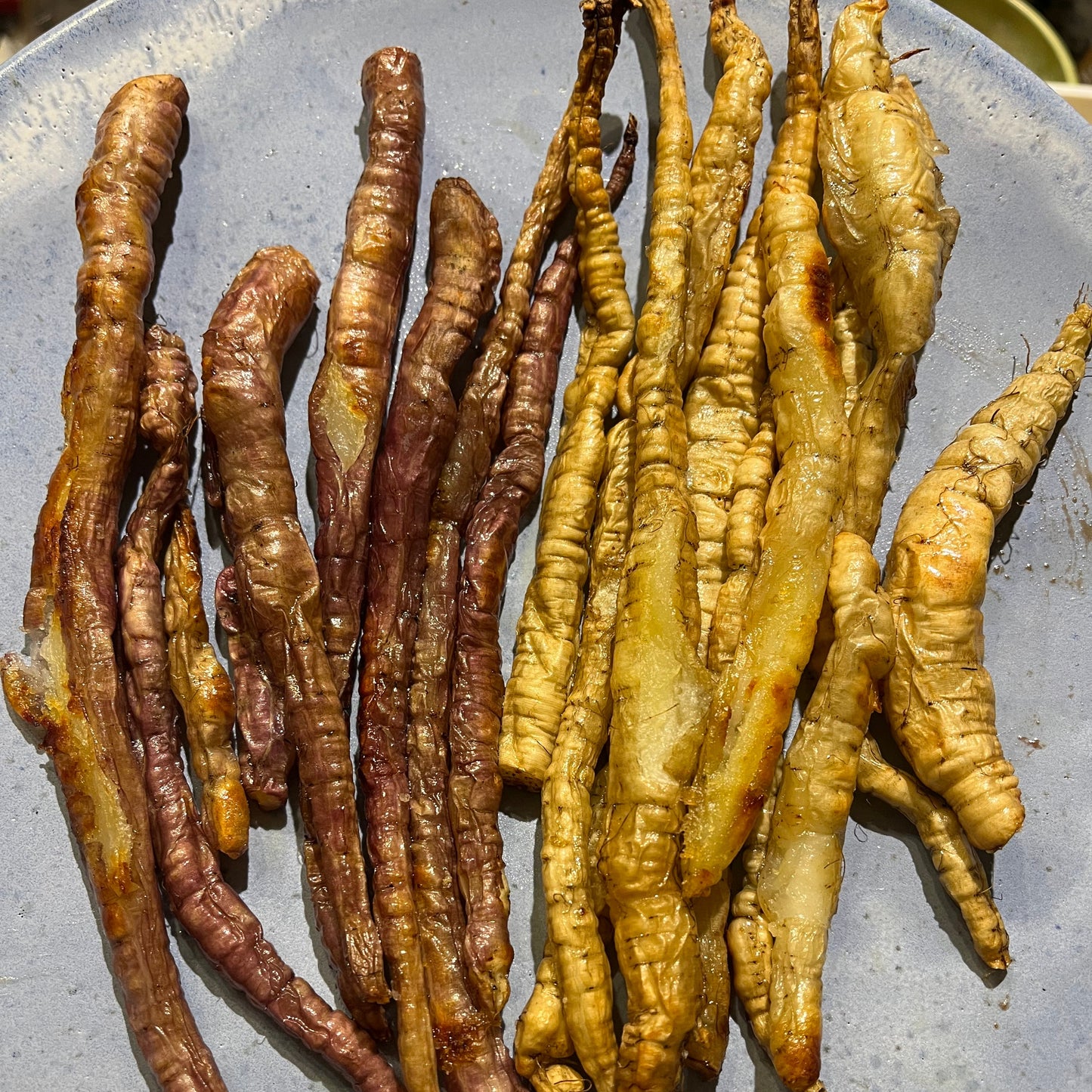
These seeds will produce plants with pure white, blush pink, and dark pink roots. The dark pink roots seem to be the rarest. Some plants have mostly white roots with only a few pink roots. So far I've found all the plants to produce thick roots with minimal presence of the woody core that some plants can have. Some roots are branching.
Interestingly, my plants took over a year to produce the pink pigment. I sowed them in spring 2024, and then I dug them up in April 2025, no roots were pink. I divided them and transplanted them at my lease site, and lo and behold, when digging them up in fall 2025, several plants had turned pink!
I will be continuing to select for large, smooth, pink roots with no woody cores. My goal is to create a high quality pink skirret that grows true from seed. But in the meantime the diversity of colours is like a treasure hunt!
Many thanks to Peter Laßnig for sharing seeds of his long-time breeding project!
General Skirret Information
Skirret is a delicious perennial root vegetable in the carrot family. It produces masses of long off-white roots that taste somewhat like a potato crossed with a carrot and a parsnip. They are great roasted, but can also be boiled, fried, stewed, added to soups, or eaten raw grated or out of hand. The roots do not need to be peeled, although some roots have a thin woody core that is easily removed by the diner after cooking. The spring shoots can be eaten, as well as the mature leaves, which taste like celery leaf or parsley.
If started early enough from seed, they can make large enough roots to eat by fall. But for the best harvest wait until the second year at least. Yields will keep increasing after that.
Seed Starting Method
I failed for years to start skirret from seed until I learned that they need fluctuating temperatures to germinate. Sow seeds outdoors in small pots in early spring when the nights are still cool (below freezing is fine) and you should have excellent germination. If it's already warmed up, sow your seeds in a small pot and alternate putting the pot outside in the sun or at room temperature, and in the fridge for a day or two at a time. Or try sowing in the fall, or even wait until the following spring to sow. I've found skirret seeds to stay viable for at least two years.
Harvesting
To harvest, wait until the top has died back in the fall, then dig up the whole plant. Cut off the largest roots, and replant the rest of the crown. If any offsets have formed around the base, you can pull or cut those off and plant them separately. The main crown can often be divided into multiple new plants using a sharp knife. Roots can be harvested all winter, and probably all year, although the flavour is probably best from fall-early spring.
Clean roots with a strong stream of water. A pressure washer works particularly well. Roots may need a quick scrub in the kitchen sink, depending if your soil has a tendency to cling to the roots.
Skirret is a "forgotten" crop, which likely fell out of favour because it was difficult to cultivate using modern industrial agriculture methods. But it's very easy to grow for the backyard gardener! It's native to China or Asia more broadly, and was wildly popular in Europe in the middle ages.
Growing conditions
Skirret does best in full sun, but part shade may be ok as well. Well drained soil is best, but it seems to do fine in heavy or clay soil as well, as well as swampy soils. Not drought tolerant.
Growing Instructions
Skirret seeds can be challenging to germinate. I recommend sowing outdoors in pots in early spring when night temperatures are still cool (light freezes are fine), but days are warm. It seems that oscillating temperatures are the key to getting these seeds to germinate (cool nights and warm days). Keep the soil moist and they should all germinate within a few weeks as long as it's not too cold.
Some people recommend using a heat mat indoors, but I haven't had great success using that method. If you want to get a jump start on the season, you could try putting the pot in and out of the fridge every day or every few days, perhaps alternating with a heat mat.
Once enough seedlings have come up and they are large enough to handle, plant them in the garden about 1 to 1.5 feet apart.
Share